
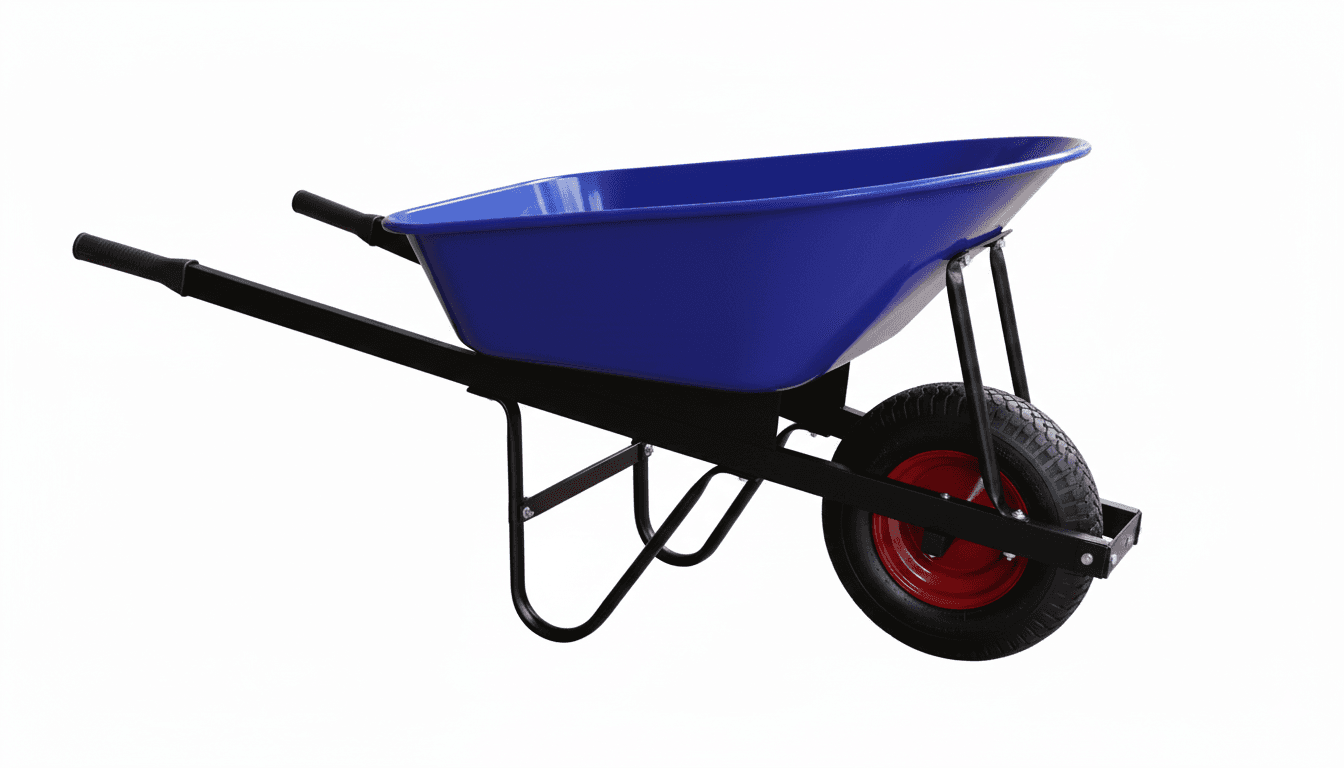
Wheelbarrows are one of the most price-sensitive product categories in construction supply. Getting the spec right for your market is the key to repeat orders.
Capacity: Match to the Job
| Capacity | Best application |
|---|---|
| 50L | Light garden and small repair work |
| 70L | General construction, most popular export size |
| 80L | Medium construction sites |
| 90L | Bulk material with PP tray (cement resistant) |
| 120L | High-volume material handling |
The 70L steel tray is our highest-volume export SKU — it hits the sweet spot of capacity, weight, and price for most construction markets.
Tray Material: Steel vs Plastic
Steel tray:
- Handles sharp rubble and heavy aggregate
- Can be repaired / reformed if dented
- Suitable for all materials including hot asphalt
PP Plastic tray (90L model):
- Does not rust — key advantage in high-humidity markets
- Lighter than steel tray of equal volume
- Resists chemical attack from cement, lime, and fertilizer
- Cannot handle sharp-edged rock loads
Frame: Galvanized vs Powder-Coated
Galvanized (Model 01): The zinc coating provides excellent corrosion resistance. Preferred in coastal and tropical markets. Round-tube handles.
Powder-coated (Model 02): The black epoxy coating gives a clean, professional appearance. Flat handles offer better grip leverage for heavy loads. Slightly lower rust resistance than galvanized in wet environments.
For Importers
We offer mixed-SKU container orders. A standard 20ft FCL typically carries 200–300 wheelbarrows depending on nesting configuration. MOQ is 20 units per SKU, but container orders can mix models.