Wheels and tyres look like a minor detail on a concrete mixer. On site they decide how easily the machine moves, how stable it stands while mixing, and how often someone has to stop work to fix a flat. For importers, they also decide which markets a model will sell in.
Solid Tyres
Solid tyres are made of rubber all the way through. On our mixers the standard solid size is 4.00-8, fitted to models such as the CM-250-2W, CM-350-2W-S, CM-385, CM-420 and CM-450.
Advantages:
- Never go flat — no punctures from rebar offcuts, nails or sharp stone
- No pressure checks, no inner tubes, no repair kits
- Lower cost and simple to replace
Limitations:
- Less shock absorption, so the machine bounces more on rough ground
- Harder to push across soft soil, mud or sand
- More vibration is passed to the frame when moving
Solid tyres are a strong choice for markets where tyre repair is hard to find, for sites littered with sharp debris, and for mixers that stay mostly in one place.
Pneumatic Tyres
Pneumatic tyres hold air, like a car or wheelbarrow tyre. Our mixers use 5.00-12 pneumatic tyres on models such as the CM-350-2W-P and CM-500, and 5.00-10 on the CM-350-4W-P.
Advantages:
- Better grip and flotation on soft, muddy or sandy ground
- Smoother ride, which protects the frame, engine mounts and drum bearings when the mixer is moved often
- The larger diameter rolls more easily over ruts and kerbs
Limitations:
- Can puncture on sites full of nails and steel offcuts
- Need regular pressure checks — keep them at the pressure marked on the sidewall
- Higher cost than solid tyres
Pneumatic tyres suit sites with rough or soft ground and contractors who move the mixer between work areas several times a day.
Two, Three or Four Wheels
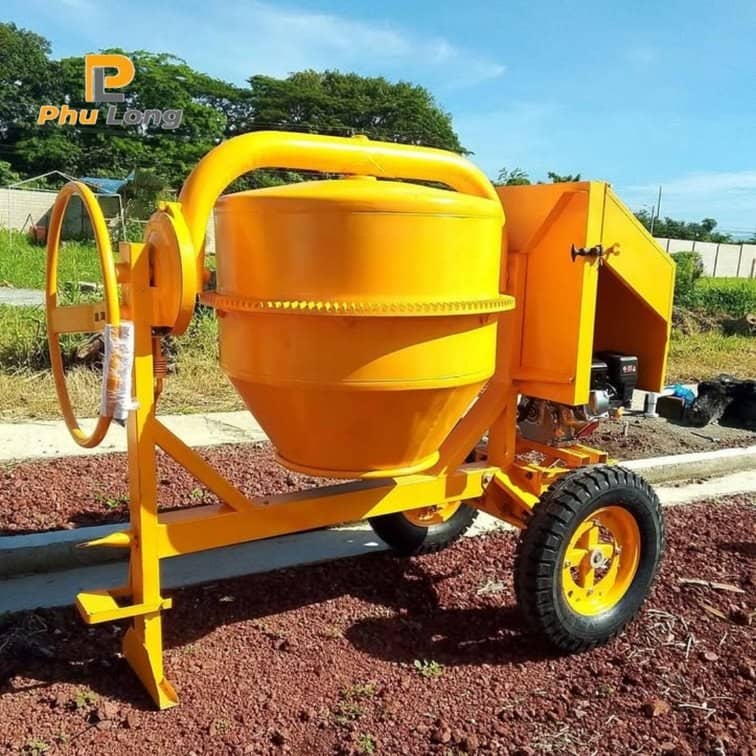
Two wheels — the classic layout. The mixer rests on two wheels and a stand or legs. It is lighter, cheaper and easy to tilt and turn by hand in tight spaces such as house plots and narrow streets.
Three wheels — adds a front wheel for easier steering and moving without lifting the front of the machine. Our CM-450 uses a three-wheel layout.
Four wheels — the most stable platform. The machine stands square on uneven or sloping ground and is easier to move a long distance across a site. Our CM-250-4W, CM-350-4W and CM-500 use four wheels.
Across the range, wheels can be specified as 2, 3 or 4, solid or pneumatic, so one model can be adapted to the conditions in your market.
Moving the Mixer Safely
- Site mixers are designed to be moved around the site, not towed at road speed. Check your local rules before using any mixer on public roads, and transport it on a truck or trailer when in doubt.
- Always empty the drum before moving the machine; a loaded drum shifts the centre of gravity.
- Lock the drum and chock the wheels once in position.
Questions to Ask Before You Order
- What ground do your customers work on — compacted, muddy, sandy or rocky?
- How often is the mixer moved during the day?
- Is tyre repair easy to find in your market?
- Do your customers prefer lighter machines they can push by hand, or stability on slopes?
A Practical Starting Point
Many importers stock both: a solid-tyre two-wheel model as the low-maintenance, price-friendly option, and a pneumatic four-wheel model for contractors who need mobility and stability. Because tyres and wheel layout are configurable, you can test both in a mixed container.
Tell us about the sites your customers work on via WhatsApp at +84 946 964 669 or our quote form, and we will suggest the right wheel and tyre setup.