Buyers often ask for "a big fan" and give a single number: airflow. But the right fan depends just as much on the resistance the air has to push through. That one question usually decides between a centrifugal fan and an axial fan.
Two Numbers That Matter: Airflow and Pressure
- Airflow (m³/h) is how much air the fan moves.
- Pressure (Pa) is how hard the fan can push that air against resistance — ducts, bends, filters, dampers, hoods and grilles.
A fan always runs at the point where its own curve meets the resistance of the system. A fan rated for a large airflow in open air can deliver far less once it is connected to a long duct with a filter. That is why both numbers must be checked together.
How Axial Fans Work
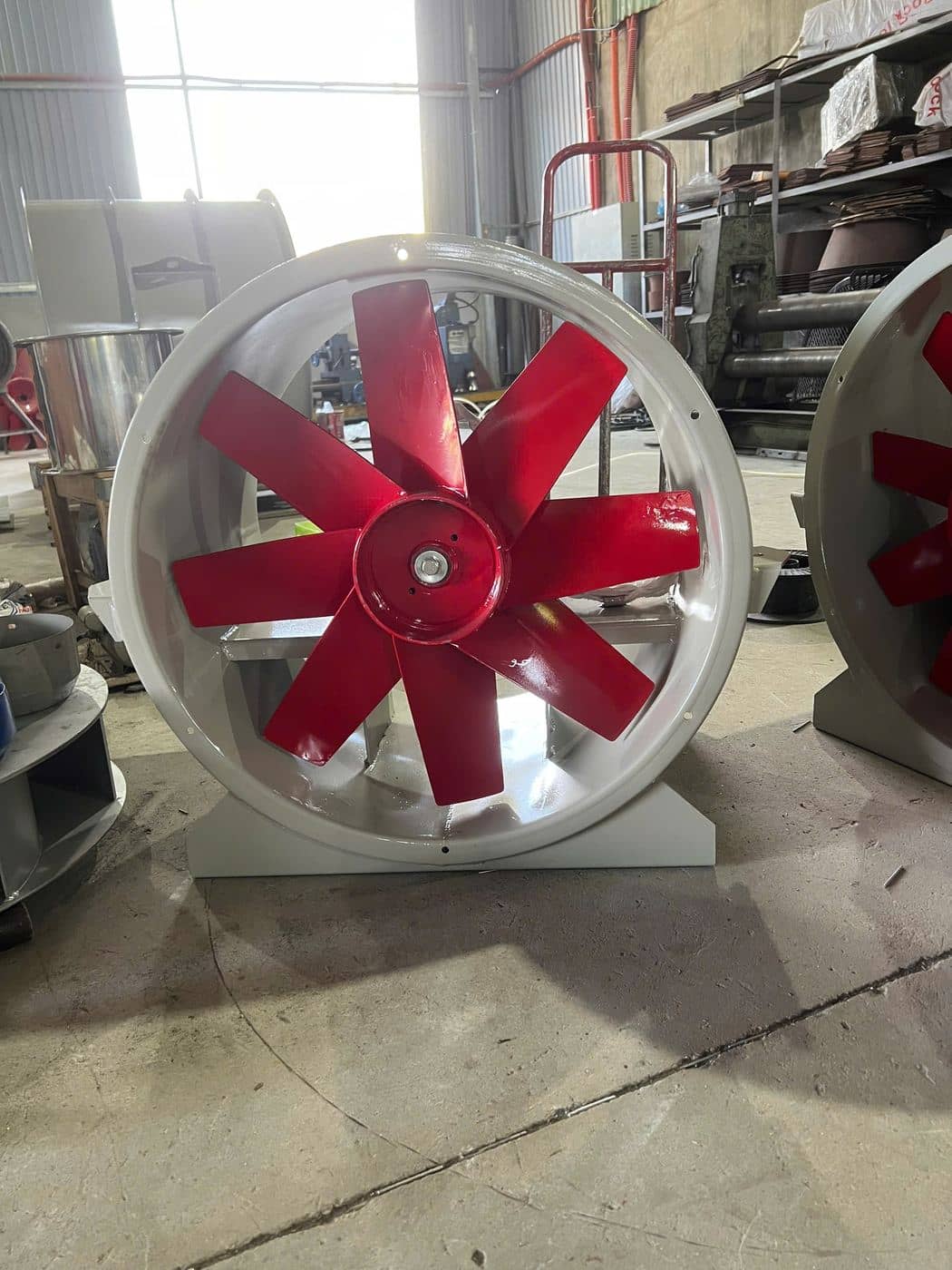
In an axial fan, air passes straight through the blades, parallel to the shaft — like a propeller. Axial fans are good at moving a lot of air over a short path with little resistance. They are generally lighter, more compact and less expensive for the same airflow.
Typical uses:
- General ventilation of warehouses, workshops and construction sites
- Fresh-air supply and hot-air extraction through a wall or short duct
- Cooling and drying areas
Our PLAX 204 axial fan covers 3,900–90,075 m³/h at 80–877 Pa, with motors from 0.25 to 22 kW, in round duct, stand-mounted and box housings.
How Centrifugal Fans Work
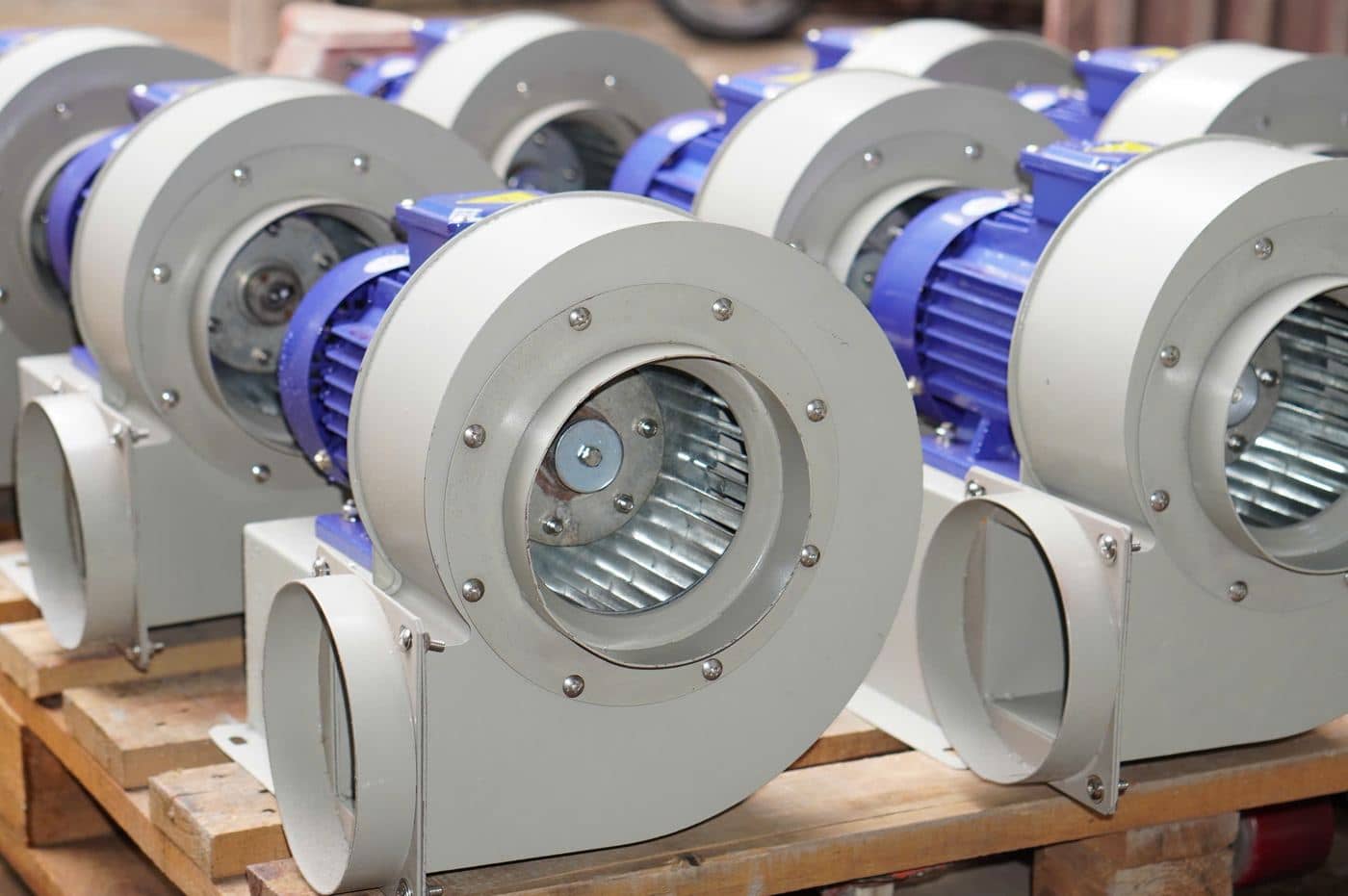
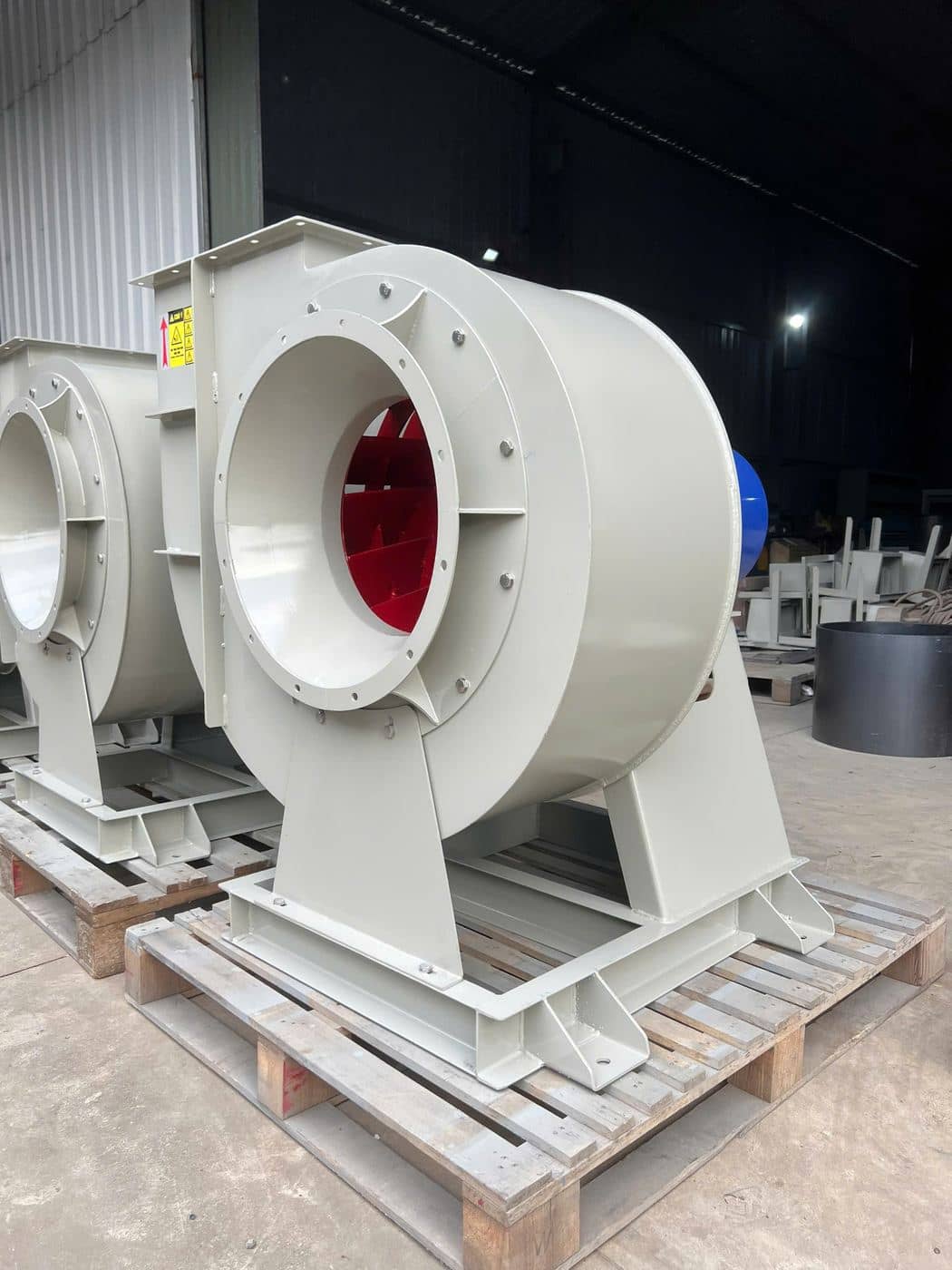
A centrifugal fan draws air into the centre of an impeller, turns it 90 degrees and throws it outward into a scroll housing. This builds much higher pressure, so centrifugal fans keep delivering airflow through long ducts, filters and hoods. They also handle dusty, hot or contaminated air better and are easier to fit with silencers.
Our centrifugal range covers three designs:
- PLCF 101, forward-curved blades — 650–57,600 m³/h at 210–2,960 Pa. Quiet ventilation and odour extraction for hotels, restaurants, factories and public buildings.
- PLCF 121, heavy-duty flat blades — 400–80,000 m³/h at 120–3,187 Pa. Air recirculation and smoke ventilation; the bolted housing opens for maintenance.
- PLCF 152, high pressure — 292–63,305 m³/h at 1,308–15,034 Pa. Forced draught for furnaces, mining tunnels and pneumatic conveying of grain, slag or coal.
A Simple Way to Decide
- Short path, open air, mostly volume — choose axial.
- Ductwork, filters, kitchen hoods or dust collection — choose centrifugal.
- Conveying material or feeding air into a furnace — choose high-pressure centrifugal.
- Hot, dusty or corrosive air — usually centrifugal, with a stainless SUS 304 option where corrosion is a concern.
Other Points to Check
- Power supply — our PLCF and PLAX fans run on 380 V, 3-phase. Confirm your site supply before ordering.
- Drive — direct drive is compact with fewer parts; belt drive lets you adjust speed by changing pulleys and is common on larger units.
- Material — SS400 steel for general duty, SUS 304 stainless for humid, food or chemical environments.
- Noise — larger, slower fans are usually quieter than small fast ones at the same airflow.
Give Us the System, Not Just the Number
The fastest way to get the right fan is to describe the job: what space or equipment you are ventilating, how long the duct is, whether there is a filter or hood, and the air temperature. With that, we can match a model to your operating point instead of guessing.
Send the details on WhatsApp at +84 946 964 669 or through our quote form, and we will come back with a recommended model and configuration.